
Your World, In Focus: Mexico World Cup Security Assessment
KEY INSIGHTS
Mexico is preparing to host the FIFA World Cup for the first time in over 40 years amid a volatile and complex security environment shaped by recent cartel violence, elevated criminality and increasing cyber threat activity. While the tournament is expected to proceed under a heavy federal security posture, the operating environment will remain elevated. For corporate travelers and businesses, the primary risks stem from opportunistic crime, cyber-enabled fraud, transport disruption and collateral exposure to cartel-related instability rather than deliberate targeting. Risk varies by city: Guadalajara presents the highest security concern, Mexico City the widest disruption footprint, and Monterrey the most manageable, though still elevated, operating environment.
KEY EVENTS
Mexico will host 13 World Cup matches across Mexico City, Guadalajara and Monterrey, with the opening match scheduled for June 11 in Mexico City.
Authorities plan to deploy approximately 100,000 security personnel across the tournament footprint.
Recent cartel violence following the killing of Jalisco New Generation Cartel (CJNG) leader “El Mencho” triggered an estimated 250 roadblocks, arson and transport disruption across multiple states.
ANALYSIS
National Security Environment:
Concentric assesses Mexico’s security environment will remain manageable but not stable, with security operations likely to trigger localized disruptions that impact travel and business activity.
While federal authorities will aim to secure priority locations, it is unlikely to eliminate all localized disruptions driven by criminal activity amidst heightened enforcement operations.
Mexico enters the tournament under pressure to demonstrate control over its internal security environment while maintaining international confidence. Federal forces have recently targeted cartel leadership in high-profile operations, most notably against the CJNG, triggering rapid and geographically dispersed retaliation. Roadblocks, arson, and transport disruption occurred across at least 20 states in the aftermath of the operation, reflecting how enforcement activity can generate immediate second-order impacts for travelers and businesses. Following recent violent incidents, FIFA officials expressed concern about the ability to secure matches scheduled on Mexican soil.
Ahead of the World Cup, authorities have announced a nationwide deployment of approximately 100,000 security personnel, supported by military assets, surveillance systems, and coordinated planning with FIFA. This posture strengthens venue security and infrastructure protection but increases operational friction.
Official estimates suggest Mexico will host over 5.5 million international visitors, generating between US$1.8 billion and US$3 billion in economic impact. During the event, expect layered screening, controlled access zones, road closures and short-notice routing changes, particularly around match days.
Event-Driven Risks:
Concentric assesses the World Cup will heighten existing security risks, with exposure increasing across crowded locations, transit phases, and digital systems.
The World Cup will see the amplification of entrenched security challenges amidst significant international attendance. Higher visitor density, compressed itineraries, and heavy reliance on digital systems expand exposure across physical and cyber domains. The successful high-profile attendance of the event will require pre-travel preparations and effective security mitigations.
Physical risks will concentrate at predictable pressure points: airports, hotels, fan zones, nightlife districts, and transport corridors.
Opportunistic crimes including pickpocketing, robbery, scams, and express kidnapping remain the most probable threat vector. Exposure will concentrate in movement phases, airport arrivals, hotel transfers, unscheduled routing, and late itinerary changes.
Latent organized criminal targeting adds a secondary layer, not commonly seen at major international events, through potential acts of extortion and opportunistic targeting of businesses in high-traffic areas.
We assess logistical disruptions will be amongst the most likely risks at the World Cup.
Despite a recent agreement between taxi drivers and Uber, disputes remain, notably surrounding airport pickup privileges. Due to such concerns, we observed taxi drivers blockading Mexico City airport in a protest tactic likely to be repeated before and during the tournament, as established taxi groups seek to resist newer transport services. Such ride hailing apps will be banned from operating at the airport, but enforcement concerns will remain.
At the same time, infrastructure projects in Monterrey and Guadalajara remain behind schedule and are likely to be incomplete when the tournament begins. Aviation services will continue, but ongoing construction will create significant traffic concerns and increase the likelihood of traveler delays.
As with any headline global event, risks are as much digital as physical, and cyber-related risks are expected to rise sharply.
Threat reporting has identified thousands of fraudulent domains linked to ticketing, hospitality and streaming platforms. The threat pattern is consistent with major events: phishing, credential harvesting, spoofed booking changes, and payment diversion. Corporate exposure extends beyond travelers to travel teams, executive support staff, and finance functions.
City Assessments:
Mexico City (Estadio Azteca)
Concentric assesses Mexico City will see the highest levels of disruption, driven by congestion, security measures, and the potential for protest activity.
Mexico City will host the opening match and absorb the highest concentration of visitors, security assets, and official attention. It carries the widest potential disruption footprint, driven by expected security cordons, congestion, and protest activity. Recent footage has shown emerging protest activity linked to displacement concerns; such events are likely to increase and have the potential to cause localized disruptions to central routes with little notice.
Guadalajara (Estadio Akron)
Concentric assesses Guadalajara carries the highest likelihood of security disruption due to established cartel influence and potential enforcement-related volatility.
Guadalajara presents the highest security concern. Jalisco is an area of established cartel influence, raising the likelihood of disruption linked to criminal dynamics. While direct targeting of international visitors remains unlikely, collateral exposure to road disruption, and public-order incidents is credible. Amidst the planned surge in federal security officers during the event, clashes between criminal and state forces cannot be ruled out. Secure transportation, route discipline, and active monitoring are advised.
Monterrey (Estadio BBVA)
Concentric assesses Monterrey will provide the most consistent operating environment, though elevated crime levels and movement risks persist.
Monterrey offers the most consistent operating environment for corporate travel, supported by strong infrastructure and a business-focused profile. However, it remains a high-crime environment by international standards. Risk increases outside core urban districts and along major road corridors. Enhanced precautions remain necessary with federal security mitigations expected to be visible and logistically time consuming.
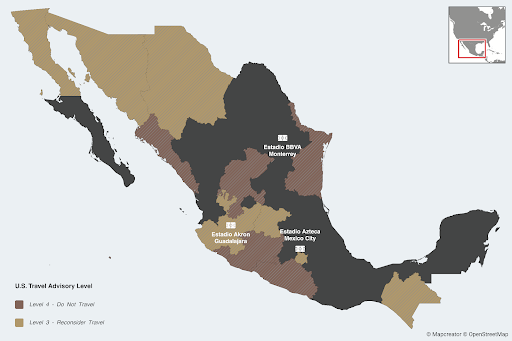
Map 1: Mexico World Cup Locations and Elevated U.S. Travel Advisories
RECOMMENDATIONS
Disruptions should be expected and Concentric’s intelligence team recommends proactive planning, controlled movements, and strengthened security and verification measures.
Mexico aims to deliver a secure tournament but entrenched security concerns mean localized disruptions are likely, elevating traveler anxiety, and creating additional security and logistical challenges.
Concentric advises businesses and travelers to take the following steps:
Plan for disruptions;
Verify bookings directly with providers;
Limit purchases to official channels;
Tighten approval processes for payments and itinerary changes;
Use pre-arranged transport; and
Avoid ad-hoc routing and build flexibility into all movements.
For senior executives and multi-city programs, maintaining real-time active threat monitoring, and relocation contingencies are advised. In addition, cyber security teams should brief all relevant attendees on the risks of phishing, spoofing and credential theft before travel.
HOW CONCENTRIC CAN HELP?
Concentric will be on the ground providing integrated support to organizations operating in Mexico during the World Cup, combining intelligence, logistics, and on-the-ground security delivery. With a federal security license and an established in-country capability, Concentric is on hand to secure your operations across Mexico City, Guadalajara, and Monterrey.
Support Options Include:
Travel risk assessments and itinerary-specific intelligence;
Travel active monitoring and alerting;
Executive protection;
Secure ground transport planning and route management; and
Crisis response, evacuation and contingency planning.
For further discussions on the security challenges your travel or organization may face during the high-profile event, contact Concentric today.